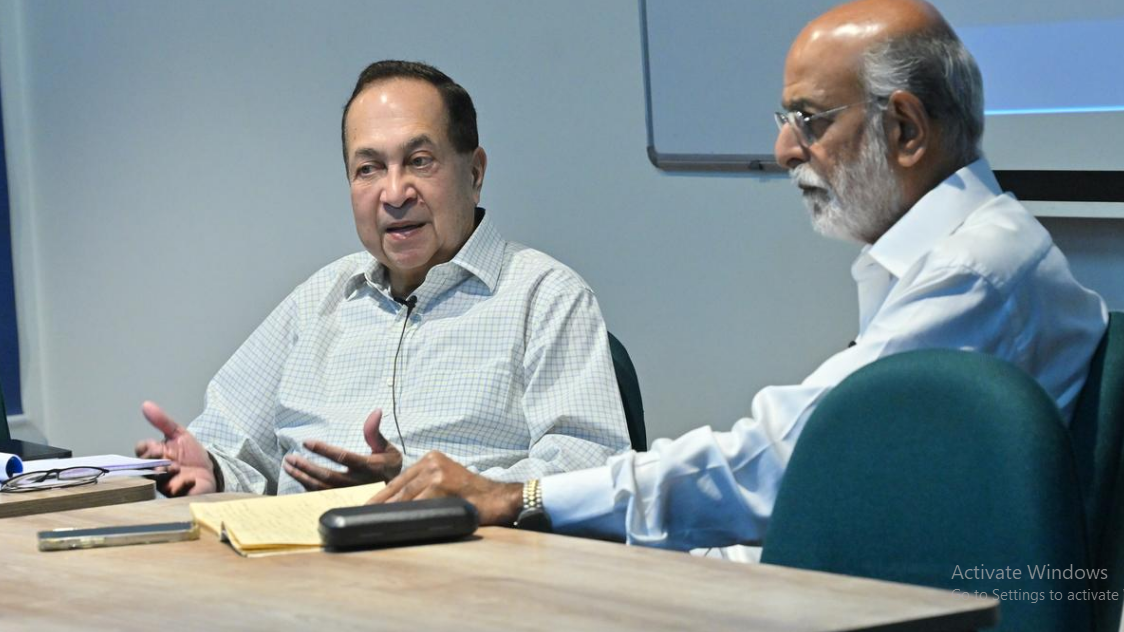
Free speech activist and founder of WikiLeaks, Julian Assange, was straight and upfront, says N. Ram at the inaugural of Media Perspectives: ‘Julian Assange and WikiLeaks: a new paradigm of journalism’

Free speech activist and founder of WikiLeaks, Julian Assange, whom The Hindu had collaborated with, in 2011 to publish articles and reports based on India Cables, was straight and upfront. N. Ram, Director, The Hindu Group Publishing Private Limited, on July 1 said ‘Julian Assange was straight, upfront to tell you what was on and what is not…brilliant and could engage in conversation on many issues and he had an impression that he had a lot of support from India and at one point he even considered getting sanctuary in India’, at an event organised here, at the Asian College of Journalism in Chennai.
WikiLeaks, founded by Mr. Assange, who was recently released from prison in the United Kingdom after he agreed to a U.S. plea deal, had released 2,51,287 cables, of which 5,100 cables were about India, which provided insights into India’s foreign policy and domestic affairs — diplomatic, political, economic, social, cultural and intellectual — observed, interpreted, and commented upon by US diplomats from 280 embassies and consulates in 180 countries, cabling the State Department in Washington D.C.
He was in conversation with Sashi Kumar, Chairman, Media Development Foundation that runs the ACJ, at the inaugural of Media Perspectives: ‘Julian Assange and WikiLeaks: a new paradigm of journalism’.
Speaking further about The Hindu’s collaboration with WikiLeaks, Mr. Ram said, “It was not a partnership because there was no financial obligations on either side. In other words, if there was a defamation charge, you face it yourself. As with the larger cache to which the cables belonged, they were six categories: confidential, confidential/no foreigners, secret, secret/no foreigners, unclassified and unclassified/for official use only. The first contact came through P. Sainath (former journalist of The Hindu) in December 2010.”
Mr. Ram said that five newspapers — The Guardian, The New York Times, Der Spiegel, Le Monde and El País — made a mark by publishing reports on a selection of cables that provided readers worldwide with what WikiLeaks described as an unprecedented insight to the US government foreign activities.
“They put the cables through a painstaking and painfully long, slow process of redaction. Each newspaper used to go on standards and they were entirely free to process and publish the material, but you had to give credit (to WikiLeaks). The work of the journalists involved providing background, context, interpretation and comment. WikiLeaks was already under siege and that’s when I met him. He seemed to be free, but he was tagged. He could walk around the grounds, but there was a chip, which will enable them to monitor his movements. He was already a marked man,” he said.
Mr. Ram further said, “We had our eye on the India cables. In mid-February, we got serious with the MoU and it led to terms of communication: no financial obligations on either side, and how to redact only to the minimum extent, where necessary…for us, it basically meant when innocent lives were at risk and strict compliance with the security protocol they laid down. He was idealistic, made it very clear, but he expected you to do a lot of rigorous research and handle the material with great care,” Mr. Ram said.
Mr. Ram also spoke about The Hindu’s Bofors’ Investigation and stories published on the Rafale deal.