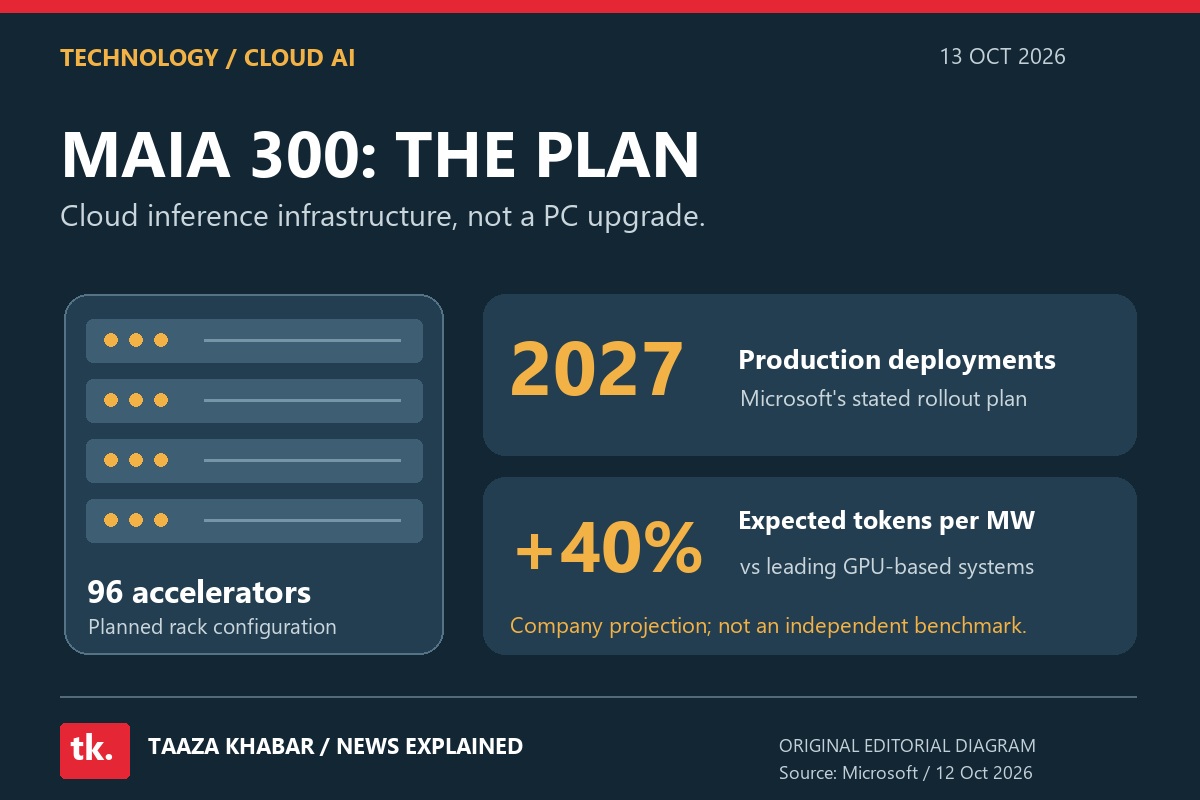
13 October 2026: Microsoft has unveiled its Maia 300 artificial-intelligence accelerator, laying out plans to begin production deployments in 2027. The October 12 announcement is about cloud infrastructure, not a chip consumers can buy for their PCs.
Key points
- Microsoft says Maia 300 will become a principal system for running AI workloads from 2027.
- The company projects about 40% more AI tokens processed per megawatt than leading GPU-based systems, but that comparison is Microsoft’s claim.
- A 96-accelerator rack is intended for demanding reasoning and agent workloads, not ordinary desktop upgrades.
What Microsoft announced
The company says Maia 300 is designed for inference: using trained artificial-intelligence models to answer queries, generate content and complete tasks. It is being developed as a complete system with chips, memory, networking and software rather than as a standalone retail processor.
According to Microsoft’s October 12 technical announcement, Maia 200 is already serving production workloads. The new Maia 300 family is expected to underpin larger deployments from 2027, with the company referring to a multi-gigawatt infrastructure scale. That is a forward-looking rollout plan, not evidence that Maia 300 is already running customer services.
Microsoft says a full 96-accelerator Maia 300 configuration could provide up to seven times the rack-level token throughput of Maia 200. Its published energy-efficiency comparison is against an unspecified group of leading GPU systems, so independent like-for-like benchmarking will be important.
Why it matters
The announcement shows how cloud providers are trying to control more of their own computing costs and chip supply. AI assistants and automated workplace systems can consume large amounts of processing power, electricity and capacity. Better performance per unit of energy could help a provider offer more AI workloads without raising electricity demand at the same rate.
However, users should not interpret the benchmarks as a promise of cheaper subscriptions or faster features next month. Microsoft’s initial deployment target is 2027, and product-level impacts have not been quantified. Microsoft’s architecture report describes a system that coordinates computing, memory and networking across a rack. These are the manufacturer’s announced specifications and performance claims, rather than independently verified benchmark results.
For people following consumer devices, this is separate from Microsoft’s Surface Laptop Ultra launch coverage. Cloud inference chips and laptop processors solve different problems.
Sources
Image: Original editorial diagram by Taaza Khabar, created 13 October 2026. It illustrates Microsoft’s announcement and projections; it is not a photograph or an image of the actual Maia 300 hardware. Licensed CC BY 4.0. No third-party photograph or product artwork was copied.
AI-assisted editorial disclosure: Drafted with AI assistance and reviewed against the linked source reports. Date: 13 October 2026.



Leave a Reply